
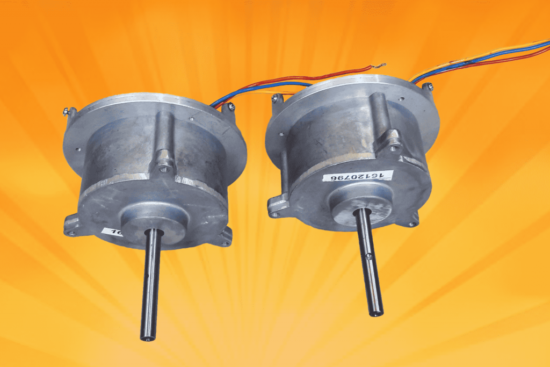
Introduction to Motor Trade-Off Analysis
When selecting a permanent magnet motor drive for industrial equipment, design engineers must balance immediate capital expenditure (CapEx) against long-term operational expenditure (OpEx). The two dominant motor technologies in fractional and integral horsepower applications are Brushless Direct Current (BLDC) Motors and Permanent Magnet Direct Current (PMDC Brushed) Motors.
While both motor types utilize permanent magnets to produce magnetic field flux, their divergent commutation methods—electronic inverter switching for BLDC versus mechanical carbon brushes for PMDC—result in major differences in electrical efficiency, speed capability, maintenance demands, and overall drive system cost. At Globe Scott Motors manufacturing expertise, we assist OEMs in evaluating ROI and technical suitability across both product lines. Explore our complete brushless DC (BLDC) motor series and our standard high-performance PMDC motors catalog.
1. Quantitative Comparison Matrix
| Performance Category | PMDC Motor (Brushed) | BLDC Motor (Brushless) | Winner / Key Distinction |
|---|---|---|---|
| Electrical Efficiency (η) | 78% to 88% | 88% to 95% | BLDC wins by eliminating brush friction & voltage drop. |
| Initial System Cost (CapEx) | Low (Simple motor + basic PWM controller) | Moderate to High (Requires 3-phase inverter controller) | |
| BLDC wins CapEx for low-budget OEM builds. | |||
| Maximum Rotational Speed | 1,500 to 5,000 RPM (Brush bounce limit) | Up to 50,000+ RPM (Limited only by bearings) | |
| BLDC wins for high-speed spindles/fans. | |||
| Operating Lifespan | 2,000 to 5,000 hours (Brush wear limit) | 20,000+ hours (Bearing grease limit) | |
| BLDC wins for 24/7 continuous operation. | |||
| Maintenance Overhead | Periodic brush inspection & dust removal | 100% Maintenance-free operation | |
| BLDC wins for sealed/inaccessible locations. | |||
| Acoustic & Electrical Noise | Higher (Brush arcing EMI & mechanical contact) | Ultra-quiet (Zero electrical arcing) | |
| BLDC wins for medical & cleanroom environments. |
2. Deep-Dive Financial and Technical Analysis
A. Electrical Efficiency & Energy Consumption
In a PMDC motor, electrical current passing through carbon brushes experiences a constant 1.0V to 2.0V voltage drop across the brush-commutator contact zone. Furthermore, mechanical brush friction generates heat. By contrast, a BLDC motor eliminates physical brushes, transferring energy to stationary stator windings via low-resistance MOSFET/IGBT switches. In continuous 24/7 industrial operations, the 7% to 10% efficiency advantage of BLDC motors translates into substantial electricity cost savings over the machine's lifetime.
B. CapEx vs OpEx (Total Cost of Ownership)
- Short-Term CapEx Focus: PMDC motors deliver a significantly lower initial purchase price because they do not require complex 3-phase micro-controller drivers. They can operate directly from a DC battery or simple PWM voltage regulator.
- Long-Term OpEx Focus: BLDC motors demand a higher initial investment in electronic controllers. However, because they require zero brush replacement downtime, draw less power, and last 4 to 10 times longer, BLDC motors achieve a lower Total Cost of Ownership (TCO) in continuous-duty applications.
For routine maintenance protocols on brushed motors, consult our DC motor maintenance and brush inspection guide. Learn more about basic DC motor advantages in our guide on key benefits of using DC motors.
3. Speed Range and Torque Control Comparison
PMDC motors offer simple linear speed control directly proportional to terminal voltage ($V ∝ \text{RPM}$). However, physical brush bounce limits their maximum safe operating speed to approximately 5,000 RPM. Operating brushed motors above this limit accelerates commutator erosion and electrical arcing.
BLDC motors suffer no mechanical speed limits from brushes, allowing them to achieve ultra-high rotational speeds exceeding 20,000 to 50,000 RPM in centrifugal blowers, medical drills, and CNC spindles. When paired with digital Field-Oriented Control (FOC) drivers, BLDC motors deliver smooth torque control across wide speed ranges. For applications requiring low output speeds and high torque, both motor types can be paired with gearheads; explore our specialized heavy-duty PMDC geared motors and broader industrial geared motor solutions.
For more details on BLDC technology, read our core guide on what is a BLDC motor and its principles or review our standalone guide on what is a PMDC motor and its working principle.
4. Frequently Asked Questions (FAQs)
Q1: Is a BLDC motor always better than a PMDC motor?
Not necessarily. For applications where initial cost is paramount, duty cycles are intermittent, or control simplicity is required (e.g., simple 12V power window actuators or low-cost power tools), PMDC motors remain the superior commercial choice.
Q2: How much energy can a BLDC motor save compared to a PMDC motor?
BLDC motors typically consume 10% to 15% less electrical energy for equivalent mechanical shaft output, significantly extending battery runtime in portable devices.
Q3: What causes PMDC motor brushes to wear out?
Brush wear is caused by mechanical friction against rotating commutator bars and localized electrical arcing (sparking) during current reversal.
Q4: Why does a BLDC motor require an electronic controller while a PMDC motor does not?
A PMDC motor uses mechanical commutator segments to flip current direction in rotor coils automatically as it rotates. A BLDC motor lacks mechanical commutators, requiring an external electronic inverter to energize its 3-phase stator coils sequentially.
Q5: Which motor is quieter during operation?
BLDC motors are significantly quieter because they eliminate mechanical brush sliding friction and electrical arc noise.
Q6: Can PMDC motors operate at high ambient temperatures?
Yes, provided high-temperature magnets and Class H (180°C) insulation are specified. However, brush wear accelerates at elevated temperatures.
Q7: Which motor technology is preferred for electric vehicle (EV) drives?
BLDC (and permanent magnet synchronous PMSM) motors are universally preferred for EV traction drives due to their high efficiency (95%+), continuous high-speed capability, and zero maintenance requirements. Explore industrial and automotive motor applications for more insights.
Q8: Where can I get technical advice to select between BLDC and PMDC for my product line?
You can consult directly with our application engineers at Globe Scott Motors. Visit our contact our motor engineering specialists page to request drive recommendations.
Conclusion
Choosing between BLDC and PMDC motors requires balancing efficiency targets, speed requirements, operational lifespan, and initial budget constraints. PMDC motors remain the undisputed leader in low-cost, high-starting-torque, simple DC applications. BLDC motors dominate continuous 24/7 operations, high-speed applications, and energy-critical equipment.
At Globe Scott Motors, we manufacture both custom PMDC brushed motors and state-of-the-art BLDC drives tailored to your specific application requirements. Contact our engineering team today to review your project specifications.