
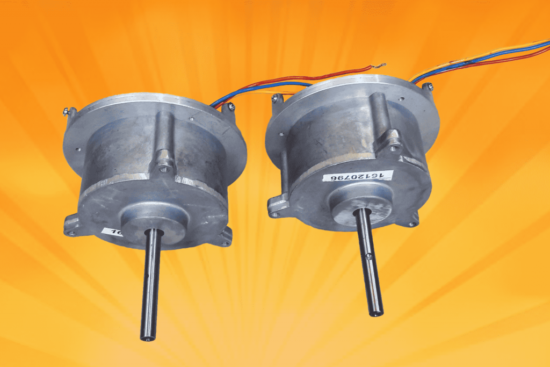
Introduction to Motor Selection Dilemma
When engineering modern industrial machinery, design teams frequently face a fundamental choice: Should they specify a traditional **Brushed Permanent Magnet DC (PMDC) Motor** or upgrade to a **Brushless DC (BLDC) Motor**? Both motor technologies convert electrical direct current into mechanical rotation, but their internal commutation mechanics, efficiency, control complexity, and lifecycle costs differ significantly.
As a manufacturer producing both PMDC and BLDC motors, Globe Scott Motors provides an objective engineering comparison to help OEMs make informed decisions. Explore our premier BLDC Motor Manufacturer in India range, our specialized PMDC Motor Manufacturer in India catalog, and our complete DC Motor Manufacturer in India portfolio.
1. Technical Comparison: Brushed DC vs BLDC
| Performance Parameter | Brushed DC (PMDC) Motor | Brushless DC (BLDC) Motor |
|---|---|---|
| Commutation Mechanism | Mechanical (Carbon brushes & copper commutator bars). | Electronic (Inverter switching via Hall sensors or sensorless back-EMF). |
| Energy Efficiency | 70% to 80% | 88% to 94%+ |
| Operating Lifespan | 2,000 to 5,000 hours (Limited by brush wear). | 20,000+ hours (Limited only by ball bearing life). |
| Drive Control Requirement | Simple 2-wire connection (Direct DC or PWM controller). | Requires 3-phase electronic BLDC inverter drive. |
| Initial System Cost | Low initial motor & control cost. | Higher motor & electronic controller cost. |
| EMC / Electrical Noise | Higher (Commutator brush arcing). | Ultra-low (Zero arcing). |
2. When to Choose Brushed DC (PMDC) Motors
- Cost-Sensitive OEM Machinery: When low initial purchase price is the primary tender requirement.
- Simple 2-Wire DC Operation: Applications running directly off 12V/24V batteries without complex electronic controllers.
- High Starting Torque under Intermittent Duty: Winches, level crossing barriers, and door operators operating under short S2/S3 duty cycles.
3. When to Upgrade to Brushless DC (BLDC) Motors
- 24/7 Continuous Duty Operation: AGVs, industrial fans, pumps, and conveyors running continuously where maintenance downtime is unacceptable.
- Maximum Battery Runtime: Battery-powered EVs and mobile robots where 90%+ motor efficiency extends operating range per charge.
- Cleanroom & Explosive Environments: Pharmaceutical, chemical, and medical devices where carbon brush dust or sparking arcs are prohibited.
For custom reduction gear drives, explore our PMDC Geared Motor Manufacturer in India and Geared Motor Manufacturer in India ranges. For transaxle applications, view our PMDC Transaxle Motor Manufacturer in India page. For maintenance procedures, check our DC motor maintenance and brush inspection guide and our guide on key benefits of using DC motors. For PMDC principles, review what is a PMDC motor and its selection guide.
4. Frequently Asked Questions (FAQs)
Q1: Is a BLDC motor always better than a brushed PMDC motor?
Not always. While BLDC motors offer higher efficiency and longer life, brushed PMDC motors remain superior for budget-sensitive applications requiring simple 2-wire control and high intermittent starting torque.
Q2: Can a BLDC motor be connected directly to a DC battery?
No. BLDC motors require a 3-phase electronic drive controller to commutate stator windings sequentially.
Q3: What is the ROI payback period when switching from PMDC to BLDC?
In continuous 24/7 industrial plants, energy savings and eliminated brush maintenance offset the higher BLDC controller cost within 6 to 12 months.
Q4: Do BLDC motors generate less heat than PMDC motors?
Yes. Because BLDC motors place windings on the stationary outer stator, heat dissipates directly through the casing, resulting in cooler operation.
Q5: Which motor type is quieter?
BLDC motors are significantly quieter (<45 dBA) because they eliminate sliding carbon brush contact noise.
Q6: Are Globe Scott Motors' BLDC motors manufactured in India?
Yes. Globe Scott Motors manufactures high-performance BLDC motors and drives in Gujarat, India.
Q7: What speed range do BLDC motors support?
BLDC motors maintain full rated torque across wide speed ranges, from 100 RPM up to 20,000+ RPM under electronic vector control.
Q8: How can I request a technical comparison for my OEM machine?
Submit your machine specifications to our engineering specialists via our contact our motor engineering specialists page.
Conclusion
Selecting between Brushed DC and Brushless DC motors requires balancing initial cost, operating efficiency, maintenance expectations, and control complexity.
Globe Scott Motors manufactures both PMDC and BLDC motor drives in India. Contact our application engineers today for unbiased technical sizing guidance.