
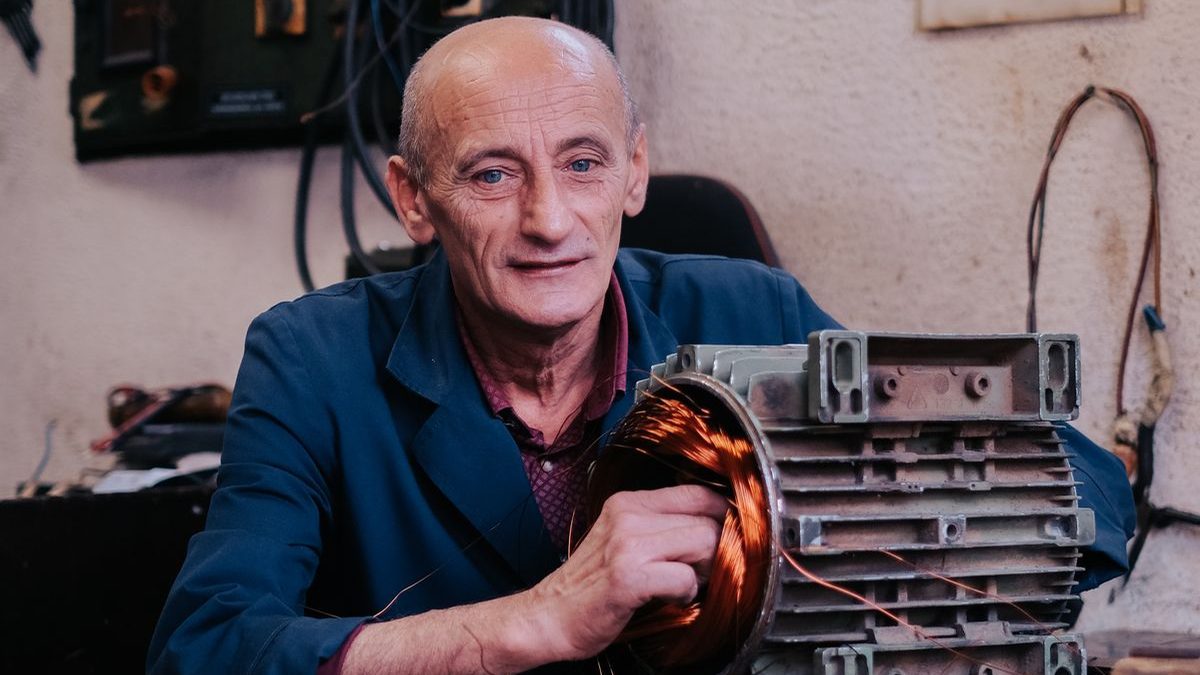
The engineer who specified the motor is rarely the person who maintains it. Three years later a maintenance manager inherits a fleet of machines and a service interval nobody discussed at purchase. This piece is for that person, and for the engineer who wants the next specification to account for what happens after commissioning.
What Actually Wears in a Brushed Motor
Three components consume life in a permanent magnet DC motor, and only one of them is designed to.
1. The Brushes
Carbon or copper-graphite brushes are pressed against the rotating commutator by springs. They are a sacrificial component, deliberately softer than the copper they run on, so they wear rather than damaging the commutator. Industrial-grade brushes typically last 3,000 to 5,000 operating hours, though the figure moves substantially with load, ambient temperature, running speed and how clean the environment is.
2. The Commutator
The segmented copper drum the brushes run on. It wears far more slowly than the brushes but not indefinitely. Over successive brush sets it develops grooving, and the mica insulation between segments can stand proud of the worn copper, which then lifts the brushes and causes arcing. At that point the commutator needs skimming and the mica undercutting, which is a workshop operation rather than a field one.
3. Carbon Dust
The by-product of normal brush wear is conductive carbon dust. Inside the brush chamber it is expected. Allowed to accumulate across the commutator or into the windings, it creates leakage paths and accelerates everything else. This is why our frames use totally enclosed, fast-replacement or external-column brush housings, so dust stays contained and inspection does not mean stripping the motor. Field procedures are covered in our DC motor maintenance guide and in common DC motor problems, troubleshooting and preventive maintenance.
Why Brushless Eliminates That Failure Mode, and What Replaces It
A brushless motor has no sliding electrical contact at all. Windings sit on the stationary stator, magnets rotate, and a three-phase inverter does the commutation electronically. Brush wear, commutator wear and carbon dust simply do not exist. Service life becomes bearing-limited, typically 20,000 hours and beyond.
But nothing is free, and the honest framing is that the failure mode moves rather than vanishes.
- Bearings become the wear item. Still the longest-lived component, but now the one that defines overhaul.
- The controller becomes a maintenance object. Electrolytic capacitors age, power semiconductors fail thermally, and a controller in a hot cabinet has its own life expectancy. A brushed motor's "controller" may be a switch.
- Diagnosis needs different skills. Worn brushes are visible and a technician can judge them by eye. A controller fault needs instruments and firmware knowledge. Some maintenance teams are set up for this and some are not.
- Repair is often replacement. A brush set is a consumable. A failed inverter is usually a module swap.
Our BLDC motor range and the background piece on what a BLDC motor is cover the construction in more detail.
A Five-Year Maintenance Comparison
The figures below are an illustrative model, not a quotation. Substitute your own labour rates and downtime costs, because those usually dominate.
Assumptions: single-shift operation at roughly 2,000 running hours per year, so 10,000 hours over five years. Brush life taken at the middle of the 3,000–5,000 hour band.
| Event | Brushed PMDC | Brushless BLDC |
|---|---|---|
| Brush inspections over 5 years | Roughly 5, one per year | None |
| Brush replacements over 5 years | 2 to 3 sets | None |
| Commutator skim / mica undercut | Likely once | Not applicable |
| Bearing service | Typically none in 5 years | Typically none in 5 years |
| Controller risk | Minimal or none | Present; ages in hot enclosures |
| Planned downtime events | 2 to 3 | 0 to 1 |
| Upfront hardware cost | Lower | Higher |
The decisive variable is almost never the price of a brush set. It is what a planned stoppage costs you. On a machine where a service visit means a technician, a ladder and twenty minutes, brushed maintenance is trivial. On a machine embedded in a production line, or mounted at height, or in a sealed cabinet, or in a remote installation, each of those two-to-three stoppages carries a cost that swamps the hardware difference.
Run the arithmetic on your own numbers:
Five-year brushed service cost = (brush sets × part cost) + (stoppages × labour) + (stoppages × downtime cost) + commutator skim
If that total is smaller than the extra upfront cost of a brushless motor plus its controller, brushed wins. If it is larger, it does not. Efficiency differences then sit on top of this, and the operating-cost arithmetic for those is worked through in motor efficiency ratings explained for equipment buyers.
Extending Brush Life When Brushed Is the Right Answer
- Match brush grade to duty. Grade selection for load, speed and humidity is a real engineering choice, not a commodity purchase.
- Control the ambient. Heat accelerates wear on both the brushes and the insulation, as covered in motor insulation classes explained.
- Avoid chronic overload. Higher armature current means more heat at the contact face and faster wear.
- Keep the chamber clean. Blow out carbon dust at every inspection rather than only at replacement.
- Replace as a set. Mixing a new brush with a bedded-in one gives uneven current sharing and shortens both.
When Brushed Is Still the Right Economic Choice
Frequently, and the maintenance argument does not overturn it:
- Low annual hours. A barrier or door operator running a few hundred hours a year may never reach a first brush change in the machine's life. See DC motors for automatic doors and gates.
- Accessible installations. Where a service visit is cheap, the sacrificial wear item is an advantage, not a liability.
- No control electronics in the product. Adding an inverter to a machine that has none introduces a new failure domain and new compliance work.
- Cost-driven high volume. The controller cost multiplies across every unit shipped.
The full topology comparison is in BLDC versus PMDC motors, and our PMDC motor range and PMDC geared motors cover the brushed side across 25 W to 3000 W.
Frequently Asked Questions
Q1. How often do motor brushes need to be replaced?
Industrial copper-graphite brushes typically last 3,000 to 5,000 operating hours. The exact interval depends on load, running speed, ambient temperature and environmental cleanliness, so brush life should be tracked in running hours rather than calendar months.
Q2. What is the lifespan of a brushless motor?
Because there is no sliding contact to wear, a brushless motor's life is set by its bearings, typically 20,000 hours and beyond. The practical limit on the drive as a whole is often the controller electronics rather than the motor.
Q3. Is a brushless motor really maintenance free?
The motor is close to it, but the drive system is not. Electrolytic capacitors and power semiconductors in the controller age, particularly in hot enclosures, and bearings eventually need attention. The failure mode moves from a cheap consumable to an electronic assembly.
Q4. What wears out besides the brushes in a brushed DC motor?
The commutator wears slowly and can develop grooving and proud mica between segments, which requires skimming and mica undercutting in a workshop. Conductive carbon dust from normal brush wear also has to be kept out of the windings.
Q5. How do I calculate whether brushless is worth the extra cost?
Add the brush sets, the labour for each stoppage, the cost of that downtime and a likely commutator skim across your planned service life, then compare that total with the extra upfront cost of a brushless motor plus its controller. Downtime cost usually decides it, not part cost.
Q6. Can I extend the life of brushes in an existing machine?
Yes. Match the brush grade to the actual duty, reduce the ambient temperature where possible, eliminate chronic overload, clean carbon dust from the brush chamber at every inspection, and always replace brushes as a complete set rather than individually.
Q7. When is a brushed motor still the better choice?
When annual running hours are low, when the installation is easy to service, when the product has no control electronics to build on, or when high volumes make the controller cost significant across the build. Doors, barriers, intermittent actuators and cost-driven appliance drives all fit this pattern.
Q8. Do you supply both brushed and brushless motors?
Yes. Globe Scott Motors manufactures both permanent magnet brushed DC motors from 25 W to 3000 W and brushless DC motors to customer specification, at the same plant in Killa Pardi, Gujarat.
Conclusion
The brushed versus brushless decision is usually presented as a performance comparison. In service it is a maintenance-access and downtime-cost comparison. Brushes are a cheap, visible, planned consumable. Brushless removes them and hands you an electronic assembly to look after instead.
Work out what one planned stoppage actually costs on your machine. That number, more than any efficiency figure, tells you which topology the next purchase should be.
Reviewing maintenance cost across your motor fleet?
Tell us your running hours and access constraints. We will advise where brushless pays back and where brushed still wins.