
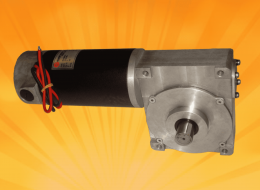
Introduction to Custom Geared Motor Engineering
In OEM equipment design, standard off-the-shelf geared motors often fall short of meeting exact mechanical requirements. Machine designers frequently encounter applications demanding a precise shaft output speed (e.g., exactly 42 RPM), high continuous output torque, specific physical dimensions, or special shaft keyways that off-the-shelf catalog motors cannot provide.
Custom Geared PMDC Motors solve this challenge by pairing a tailored PMDC motor armature winding with a custom-calculated gearhead ratio. Determining the ideal gear ratio (i) and required motor torque (τ) involves balancing mechanical power transmission equations, gear train stage efficiency (η), service factors (S_f), and environmental duty cycles. At Globe Scott Motors manufacturing expertise, we specialize in custom gear ratio selection, precision gear manufacturing, and armature winding for OEM applications. Explore our specialized heavy-duty PMDC geared motors and broader industrial geared motor solutions.
1. Fundamental Equations for Gear Ratio and Torque Selection
A. Gear Ratio Calculation (i)
The gear reduction ratio (i) defines the proportional speed reduction between the internal PMDC motor armature speed (Nmotor) and the target gearbox output shaft speed (N_{output}):
For optimal efficiency and brush life, the base PMDC motor armature should operate near its maximum efficiency point (typically between 2,500 RPM and 3,500 RPM).
B. Output Torque Calculation (τout)
Mechanical torque output delivered at the gearbox shaft is governed by:
Where τmotor is the motor armature torque, i is the gear ratio, and ηgearbox is the total mechanical efficiency of the gear train.
C. Gearhead Efficiency by Stage Count (η^n)
Every gear mesh stage introduces slight friction losses. Multi-stage gearheads reduce efficiency according to stage count (n):
| Gearbox Type | 1-Stage Efficiency (η_1) | 2-Stage Efficiency (η_2) | 3-Stage Efficiency (η_3) |
|---|---|---|---|
| Planetary Gearhead | 90% to 95% | 85% to 90% | 80% to 85% |
| Spur Gearhead | 88% to 92% | 80% to 85% | 75% to 80% |
| Worm Gearhead | 60% to 75% (Single worm) | 45% to 60% (Double worm) | N/A |
2. Step-by-Step Selection Procedure for OEMs
Step 1: Calculate Target Shaft Speed and Load Torque
Determine continuous load torque (τload), peak acceleration torque (τpeak), and target output speed (N_{output}). Apply a **Service Factor (S_f)** based on load shock conditions:
- Uniform Load (e.g., smooth fans/conveyors): $S_f = 1.0 \text{ to } 1.2$
- Moderate Shock Load (e.g., indexing tables/pumps): $S_f = 1.25 \text{ to } 1.5$
- Heavy Shock Load (e.g., crushers/stamping presses): $S_f = 1.75 \text{ to } 2.0$
Step 2: Calculate Motor Base Armature Requirements
Selecting a base motor armature operating at $N_{motor} = 3000 RPM$, the required gear ratio is $i = 3000 / N_{output}$. Next, compute required motor armature torque:
Verify that τmotor lies within the PMDC motor's continuous duty zone on its thermal curve. Learn more about basic PMDC characteristics in our guide on key benefits of using DC motors.
Step 3: Account for Radial and Axial Shaft Loads
When driving sprockets, timing belts, or heavy overhung loads, verify that gearbox output bearings support maximum allowable **Radial Load (F_{radial})** and **Axial Thrust Load (F_{axial})** to prevent bearing fatigue.
3. Shaft and Mechanical Customization Options for OEMs
Beyond selecting gear ratios, custom geared PMDC motors allow OEMs to specify tailored mechanical features:
- Custom Shaft Profiles: D-cut flat shafts, keyways, splined shafts, cross-drilled pin holes, and threaded output shafts.
- Custom Voltage Windings: Winding armatures for non-standard battery voltages (e.g., 18V, 36V, 72V DC). Explore our standard high-performance PMDC motors catalog for base frames.
- Integrated Brakes & Encoders: Adding electromagnetic holding brakes or magnetic/optical encoders directly onto rear shaft extensions.
- Enclosure Protection: Custom IP65/IP67 seals, O-rings, and potted junction boxes for outdoor washdown machinery. See industrial and automotive motor applications for real-world setups.
For maintenance procedures on custom brushed motors, refer to our DC motor maintenance and brush inspection guide. For a core overview of PMDC principles, read our foundational guide on what is a PMDC motor and its working principle or compare brushed drives with our brushless DC (BLDC) motor series.
4. Frequently Asked Questions (FAQs)
Q1: How do I select between a planetary and spur gearhead for custom PMDC motors?
Choose a planetary gearhead when high torque density, compact coaxial inline mounting, and high shock load resistance are required. Choose a spur gearhead for parallel shaft offset layouts and budget-conscious applications requiring moderate torque.
Q2: What is the impact of selecting too high a gear ratio?
Selecting an excessively high gear ratio lowers output speed beyond requirements, reduces overall system mechanical efficiency due to extra gear stages, and risks over-torquing and damaging gear teeth if the motor stalls.
Q3: What is a gearhead service factor (S_f)?
A service factor is a multiplier applied to load torque calculations to account for operational shock, duty cycles, and vibration. Applying the correct service factor prevents gear tooth stripping under sudden load spikes.
Q4: How does temperature affect custom gearhead performance?
High operating temperatures thin out gear grease, leading to increased gear tooth friction and accelerated wear. Using high-temperature synthetic grease ensures smooth performance up to 120°C.
Q5: Can Globe Scott Motors supply custom gear ratios for low-volume OEM orders?
Yes. Globe Scott Motors offers flexible custom manufacturing options for both low-volume prototype batches and high-volume OEM production runs.
Q6: What is the maximum reduction ratio possible in a single-stage planetary gearhead?
Single-stage planetary gearheads typically achieve ratios up to 10:1. Higher ratios (e.g., 50:1 or 100:1) require multi-stage gear trains (2 or 3 stages).
Q7: Can custom geared PMDC motors operate continuously 24/7?
Yes, provided continuous load torque stays within the thermal continuous rating of the motor armature and brushes are inspected at 3,000 to 5,000-hour intervals.
Q8: How can I submit my custom gear ratio and torque requirements to Globe Scott Motors?
You can submit your target speed, torque, supply voltage, and dimensional constraints to our engineering team by visiting our contact our motor engineering specialists page.
Conclusion
Selecting the right gear ratio and torque for custom PMDC geared motors requires balancing mechanical speed-torque equations, gear stage efficiency, service factors, and physical mounting constraints. Customizing gearheads ensures optimal machine performance, compact integration, and maximum reliability.
Partner with Globe Scott Motors to engineer custom geared motor solutions tailored to your OEM machinery. Contact our application team today to request engineering assistance and custom prototype quotes.