
Introduction to Motor Selection
When engineering electromechanical systems, machine designers often face a fundamental decision: Should you use a Standard Direct-Drive DC Motor or a Geared DC Motor? Both motor types convert direct current electrical power into mechanical rotation, but their mechanical output characteristics—specifically operating speed and shaft torque—are drastically different.
A standard DC motor delivers high rotational speed (typically 1,500 to 6,000 RPM) with modest shaft torque. A geared motor pairs that same motor armature with a mechanical speed reducer (gearhead) to trade high RPM for significantly multiplied torque at lower speeds (typically 1 to 500 RPM). Understanding the key differences in torque density, efficiency, mechanical backlash, and physical sizing is essential for optimizing machine performance. At Globe Scott Motors manufacturing expertise, we manufacture both custom standard DC motors and high-torque geared motors. Explore our complete high-performance PMDC motors catalog and our specialized industrial geared motor solutions to compare drive options.
1. Structural and Functional Comparison
A. Standard Direct-Drive DC Motor
A standard DC motor consists of a stator (containing field coils or permanent magnets), a rotating armature rotor with windings, a commutator, and carbon brushes. The output shaft connects directly to the driven load without intermediate speed reduction. Because there are no gear stages, mechanical efficiency is exceptionally high (up to 90%+), but the motor produces low torque at high speeds.
B. Geared DC Motor
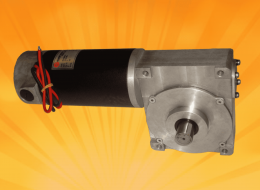
A geared DC motor integrates a standard DC motor with an enclosed gearhead (such as spur, planetary, or worm gear trains). The gear reduction ratio (i) reduces shaft speed while multiplying output torque according to the mechanical relationship:
Where τmotor is the motor's base torque, i is the gear ratio, and ηgearbox is the mechanical efficiency of the gear train (typically 65% to 95%).
2. Key Differences Breakdown Table
| Feature / Parameter | Standard Direct-Drive DC Motor | Geared DC Motor |
|---|---|---|
| Operating Speed Range | High Speed (1,500 RPM to 6,000+ RPM) | Low to Medium Speed (1 RPM to 500 RPM) |
| Shaft Torque Output | Low to Moderate continuous torque | Very High output torque (multiplied by gear ratio i) |
| Mechanical Efficiency | Higher (85% to 92%; zero gear friction losses) | Moderate (65% to 92%; depends on gear stages & type) |
| Mechanical Backlash | Zero backlash (Direct rigid shaft connection) | Present (5 to 30 arcminutes depending on gear type) |
| Holding Brake / Self-Locking | Cannot hold loads when unpowered (Easily back-driven) | Worm gearheads provide self-locking load holding |
| Physical Size per Torque Unit | Larger motor frame required for high torque | Extremely compact motor footprint for high torque |
| Acoustic Operating Noise | Quiet operation (Only bearing & brush noise) | Slightly higher noise from mechanical gear mesh |
3. Deep Dive into Performance Characteristics
A. Torque Density and Sizing
To produce 50 N·m of continuous torque using a standard direct-drive DC motor, the physical motor frame must be very large and heavy. By contrast, a geared motor pairs a small 0.5 N·m PMDC motor with a 100:1 planetary gearbox, delivering 50 N·m of torque in a package that weighs less than one-fourth of the direct-drive equivalent. For high-torque applications, explore our specialized heavy-duty PMDC geared motors.
B. Speed Regulation and Low-Speed Cogging
Running a standard DC motor at extremely low speeds (e.g., under 50 RPM) by reducing supply voltage often results in erratic motion or "magnetic cogging". A geared motor allows the internal motor armature to spin in its smooth high-efficiency zone (2,500 RPM) while delivering ultra-smooth, high-torque rotation at the gearbox output shaft.
C. Efficiency and Thermal Considerations
While standard DC motors avoid gear friction losses, operating a standard motor near stall to generate torque generates severe I2R heat in the armature coils. A geared motor operates at higher efficiency under heavy mechanical loads because the motor armature runs at high RPM where current draw is significantly lower. For basic motor efficiency guidelines, read our overview of the key benefits of using DC motors.
4. Application Match Guide
Choose a Standard Direct-Drive DC Motor For:
- High-Speed Applications: Cooling fans, blowers, high-speed centrifugal pumps, and spindles requiring 2,000+ RPM.
- Zero-Backlash Motion Control: Precision direct-drive optical scanners and gimbals where mechanical play is unacceptable.
- Simple Low-Load Machinery: Lightweight battery-operated appliances and small handheld tools. Explore industrial and automotive motor applications for industry examples.
Choose a Geared DC Motor For:
- Conveyors and Material Handling: Industrial belt drives, sorting tables, and packaging machinery requiring steady low-speed torque.
- Automated Actuators and Gates: Security sliding gates, door openers, and agricultural valve actuators.
- Medical and Mobility Devices: Hospital bed positioners, patient lifts, and motorized wheelchairs requiring holding torque and quiet operation.
For routine maintenance procedures on brushed motors, consult our DC motor maintenance and brush inspection guide. To learn more about PMDC fundamentals, read our core article on what is a PMDC motor and its working principle or compare brushed technology with our brushless DC (BLDC) motor series.
5. Frequently Asked Questions (FAQs)
Q1: Can I convert a standard DC motor into a geared motor later?
Yes, by mounting a compatible standalone gearhead (planetary, spur, or worm) to the motor's front face using an adapter flange and pinion gear.
Q2: Why does a geared motor produce more torque than a standard motor of the same size?
A geared motor uses gear reduction to trade rotational speed for torque. Mechanical power ($P = τ × ω$) remains constant (minus efficiency losses), so reducing output speed by factor i increases torque by factor i.
Q3: What is mechanical backlash in a geared motor?
Backlash is the small clearance or play between mating gear teeth. It causes a slight rotational delay or position error when reversing shaft direction.
Q4: Which gearhead type provides the lowest backlash?
Precision planetary gearheads deliver the lowest backlash (<5 to 10 arcminutes), making them ideal for positioning applications.
Q5: Do geared motors require regular oil changes?
Most small-to-medium fractional horsepower geared motors are sealed with lifetime synthetic grease (Class NLGI 2) and require no maintenance oil changes.
Q6: Can a geared motor be back-driven by the load?
Spur and planetary geared motors can be back-driven. High-ratio worm geared motors (ratios > 30:1) are self-locking and cannot be back-driven by external load forces.
Q7: How does gear reduction affect motor electrical current draw?
Because gear reduction allows the motor armature to run at high RPMs, the motor operates at lower armature current (Ia) for a given load torque compared to an un-geared motor operating near stall.
Q8: Where can I get assistance selecting between geared and standard DC motors?
Our engineering team at Globe Scott Motors can evaluate your torque, speed, and dimensional requirements to recommend the ideal motor drive. You can contact our motor engineering specialists directly.
Conclusion
Choosing between a standard DC motor and a geared motor depends entirely on your target speed and torque requirements. Standard DC motors excel in high-speed, direct-drive, zero-backlash applications, while geared motors are indispensable for compact, high-torque, low-speed industrial machinery.
At Globe Scott Motors, we manufacture standard and custom-geared motor drives engineered for heavy-duty industrial service. Contact our technical team today to discuss your project requirements.