
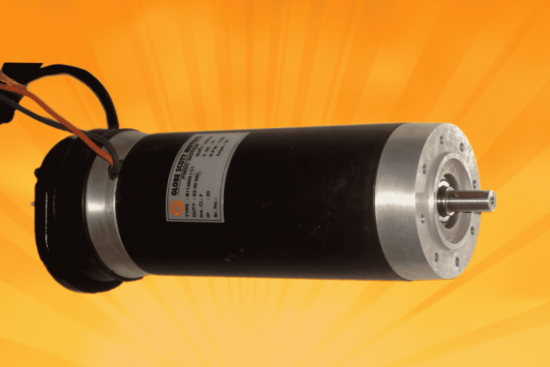
Introduction to Permanent Magnet Motor Technologies
When selecting a direct current (DC) motor for modern motion-control systems, design engineers frequently evaluate two leading permanent magnet machine architectures: Permanent Magnet Direct Current (PMDC) Brushed Motors and Brushless Direct Current (BLDC) Motors. Both motor types utilize permanent magnets on either the stator or rotor to produce magnetic flux, eliminating field winding excitation losses and delivering high power density.
However, their fundamental difference lies in their commutation mechanisms. PMDC motors rely on mechanical carbon brushes and copper commutators, whereas BLDC motors employ electronic commutation driven by external inverter circuits and position sensors (such as Hall effect sensors). Selecting between PMDC and BLDC involves balancing initial system cost, controller complexity, operational lifespan, efficiency requirements, and maintenance tolerances. At Globe Scott Motors manufacturing expertise, we manufacture both custom PMDC motors and advanced BLDC motor solutions. Explore our complete high-performance PMDC motors catalog and our specialized brushless DC (BLDC) motor series to compare specifications.
1. Construction and Commutation Architecture
A. PMDC Motor Construction (Brushed Internal Rotor)
In a standard PMDC motor, high-strength permanent magnets (Ferrite or NdFeB) are bonded to the stationary outer housing (stator). The rotating armature (rotor) contains copper coils wound around a laminated iron core. Electrical power is supplied to the spinning rotor coils through spring-loaded carbon brushes making continuous sliding contact with a segmented copper commutator mounted on the shaft.
B. BLDC Motor Construction (Brushless Outer/Inner Rotor)
In a BLDC motor, the architecture is inverted. The copper armature windings are stationary (mounted on the outer stator), while the permanent magnets rotate on the inner or outer rotor shaft. Because the windings do not rotate, power is fed directly into the stator coils without brushes. Commutation is performed electronically by switching power through a 3-phase MOSFET/IGBT inverter bridge synchronized with Hall sensor signals or back-EMF feedback.
2. Comprehensive Engineering Comparison Matrix
| Engineering Parameter | PMDC Motor (Brushed) | BLDC Motor (Brushless) |
|---|---|---|
| Commutation Method | Mechanical (Brushes & Commutator) | Electronic (3-Phase Inverter Driver) |
| System Efficiency (η) | 78% to 88% (Frictional brush & voltage drop losses) | 85% to 95% (Zero brush friction; optimized switching) |
| Operational Lifespan | 2,000 to 5,000 hours (Limited by brush wear) | 20,000+ hours (Limited only by bearing life) |
| Drive Electronics Cost | Very Low (Direct DC source or basic PWM speed controller) | Moderate to High (Requires dedicated 3-phase micro-controller driver) |
| Speed-Torque Control | Linear, simple voltage proportional control ($V ∝ \text{RPM}$) | Requires electronic closed-loop speed feedback & algorithm |
| Electrical Sparking & EMI | Occurs at commutator contact; requires filtering | Zero electrical sparking; very low acoustic & RF noise |
| Maintenance Needs | Periodic brush inspection and dust cleanout required | 100% Maintenance-free operation |
| Thermal Dissipation | Heat generated inside spinning rotor; harder to cool | Heat generated in outer stator; easy thermal dissipation |
3. Deep-Dive Performance Analysis
A. Efficiency and Thermal Management
Because BLDC motor windings reside on the stationary outer stator frame, heat generated by copper losses (I2R) dissipates easily through conduction into the metal outer casing or heat sink. In contrast, heat generated in a PMDC motor's rotating armature must radiate across an internal air gap, making thermal management more challenging during continuous heavy loads. For fundamental motor principles, read our overview of the key benefits of using DC motors.
B. Lifespan and Reliability
In PMDC motors, carbon brushes continuously rub against rotating copper commutator segments. Over time, friction wears down the brushes and generates conductive carbon dust that requires routine cleaning; consult our DC motor maintenance and brush inspection guide for details. BLDC motors eliminate physical brushes entirely, achieving maintenance-free operational lifetimes exceeding 20,000 operating hours.
C. Controller Complexity and Total System Cost
While BLDC motors excel in lifespan and efficiency, PMDC motors retain a distinct advantage in **total installed system cost**. A PMDC motor can be connected directly to a DC battery or simple fixed-voltage power supply without an expensive electronic controller. Variable speed control requires only a low-cost PWM chopper. Conversely, a BLDC motor cannot run directly from a DC voltage source; it requires an intelligent electronic speed controller (ESC) or 3-phase inverter driver, increasing initial development and hardware costs.
4. Application Match Guidelines: Where Each Motor Excels
Choose a PMDC Motor When:
- Initial Budget is Limited: You need an economical, high-torque motor for mass-produced consumer or industrial equipment.
- Control Simplicity is Required: The motor operates at fixed battery voltages or requires basic PWM speed adjustment without complex firmware.
- High Starting Torque in Compact Size is Needed: Excellent starting torque characteristics are required for stop-start indexing drives. For low-speed high-torque applications, explore our specialized heavy-duty PMDC geared motors and broader industrial geared motor solutions.
- Intermittent Duty Cycle: Operating duty cycles are intermittent (S2/S3), where total operating hours over the product lifetime will not exceed brush wear thresholds. Explore industrial and automotive motor applications for real-world examples.
Choose a BLDC Motor When:
- Continuous 24/7 Duty Operation: The machine operates continuously in mission-critical applications where maintenance downtime is unacceptable.
- High Speed (>10,000 RPM) is Required: Mechanical brushes overheat or bounce at extreme speeds, making BLDC the only viable choice for high-speed spindles and centrifuges.
- Explosive or Cleanroom Environments: Zero electrical sparking is mandated for explosive gas atmospheres or medical cleanrooms.
- Maximum Energy Efficiency: Battery life maximization is paramount in mobile robotics or portable medical devices.
For a detailed breakdown of PMDC motor selection steps, read our standalone article on what is a PMDC motor and its working principle.
5. Frequently Asked Questions (FAQs)
Q1: Can a PMDC motor be directly replaced with a BLDC motor?
Not directly without modifying the control electronics. While a BLDC motor can replace the mechanical envelope of a PMDC motor, you must install a 3-phase electronic motor controller to drive the BLDC motor coils.
Q2: Why are PMDC motors cheaper than BLDC motors?
PMDC motors use simple mechanical commutation (brushes and commutator), eliminating the need for position sensors (Hall sensors) and complex 3-phase inverter electronics required to operate BLDC motors.
Q3: Which motor provides higher starting torque: PMDC or BLDC?
PMDC motors inherently deliver very high starting torque directly proportional to armature current. BLDC motors can achieve equivalent starting torque, but require advanced electronic current-limiting drivers to prevent demagnetization during initial startup.
Q4: How long do brushes last in a quality PMDC motor?
High-grade copper-graphite brushes in industrial PMDC motors typically last between 3,000 and 5,000 operating hours depending on load duty cycle, ambient temperature, and operational RPM.
Q5: Is speed control easier on a PMDC motor or a BLDC motor?
Speed control is significantly simpler on a PMDC motor. Adjusting the applied armature voltage linearly scales motor speed. Controlling BLDC speed requires closed-loop PWM switching algorithms managed by a microcontroller.
Q6: Do BLDC motors produce less noise than PMDC motors?
Yes. Because BLDC motors have no sliding friction from brushes against commutator bars, they generate far less mechanical acoustic noise and zero electrical arc noise (RF EMI).
Q7: Can PMDC motors operate in wet or dusty environments?
Yes, provided the motor housing is built with appropriate IP protection ratings (e.g., IP65 or IP67 sealed enclosures). However, brush dust must remain isolated within the brush chamber.
Q8: Where can I get technical assistance to select between PMDC and BLDC for my project?
Our application engineering team at Globe Scott Motors can analyze your duty cycle, torque profile, and budget to recommend the optimal motor solution. You can contact our motor engineering specialists directly.
Conclusion
Both PMDC and BLDC motors offer distinct engineering advantages. PMDC motors remain the undisputed leader in cost-effective, high-torque applications requiring control simplicity. BLDC motors excel in continuous-duty, high-speed, and maintenance-free environments.
At Globe Scott Motors, we manufacture precision PMDC and BLDC motor drives tailored to your specific performance targets. Contact our engineering team today to review your project specifications.