
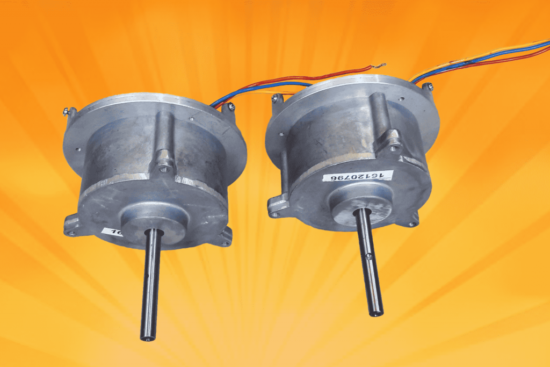
As a BLDC motor manufacturer in Killa Pardi, Gujarat, we build both brushless and brushed permanent magnet machines in the same plant. That puts us in an unusual position: we have no reason to push one topology over the other. The right answer depends entirely on how many hours a year your machine actually runs and what your control budget looks like.
The One Difference That Drives Everything Else
Both motor types use permanent magnets to create the field, so both avoid field-winding excitation losses. The difference is how current in the windings is reversed.
A PMDC motor does it mechanically. Carbon brushes slide on a segmented copper commutator and reverse armature current as the rotor turns. A BLDC motor does it electronically. The windings sit on the stationary stator, magnets rotate, and a three-phase inverter switches current using Hall sensor or back-EMF feedback. Our primers on what a PMDC motor is and what a BLDC motor is cover the physics in detail.
Every practical difference below follows from that single choice.
Side-by-Side Comparison
| Parameter | PMDC (Brushed) | BLDC (Brushless) |
|---|---|---|
| Commutation | Mechanical brushes and commutator | Electronic three-phase inverter |
| Typical efficiency | 78–88% | 85–95% |
| Service life | 3,000–5,000 h to brush change | 20,000 h+, bearing limited |
| Drive electronics | Direct DC or simple PWM chopper | Dedicated ESC or inverter required |
| Installed cost | Lower | Higher upfront |
| Maintenance | Periodic brush inspection | Essentially maintenance free |
| Sparking and EMI | Present, needs filtering | None |
Advantages and Limitations of Each
Where a PMDC Motor Wins
A PMDC motor runs straight off a battery or fixed DC supply. Speed is close to linear with applied voltage, so a low-cost PWM chopper gives you usable speed control without firmware. Starting torque is high and directly proportional to armature current, which suits stop-start indexing drives. For intermittent S2 and S3 duty, total running hours over the machine's life may never reach the brush wear threshold, in which case you are paying for a controller you do not need. Our PMDC motor range covering 25 W to 3000 W is built for exactly these cases.
Where a BLDC Motor Wins
Remove the brushes and you remove the dominant wear mechanism, the main source of electrical noise and a meaningful chunk of friction loss. Because the windings sit on the outer stator, heat conducts straight out through the casing instead of radiating across an air gap, so continuous-duty thermal behaviour is better. BLDC is the correct choice for 24/7 operation, speeds above roughly 10,000 RPM, cleanroom or explosive atmospheres, and battery-powered equipment where every percent of efficiency extends runtime. Our brushless DC motor range is designed and manufactured to customer specification, and we developed our own BISON commercial fan around a BLDC drive.
Applications We See in Practice
- Automatic doors and gates. Intermittent, high starting torque, cost sensitive. Almost always PMDC. See our DC motor selection guide for automatic doors and gates.
- Floor scrubbers and sweepers. Traction duty with an integrated gearbox, usually a PMDC transaxle, as covered in our article on motors for industrial cleaning machines.
- Solar and circulation pumps. Long continuous run hours favour brushless. Background in PMDC motors for pumps.
- Railway carriage fans. Continuous duty in a sealed enclosure, brushless. Related reading on railway signalling motors and their safety requirements.
A Two-Question Shortcut
If you want the decision compressed: how many hours per year does the motor actually turn, and does your product already contain a microcontroller? High hours plus existing control electronics points to BLDC. Low hours plus a simple DC supply points to PMDC. Everything else is refinement, and our deeper comparison of PMDC versus BLDC application fit works through the torque-curve and duty-cycle detail. For the long-run cost side, see the brushed versus brushless maintenance comparison.
Frequently Asked Questions
Q1. Which is better, a BLDC motor or a PMDC motor?
Neither is universally better. A BLDC motor is better for continuous duty, high speed, high efficiency and maintenance-free operation. A PMDC motor is better where installed cost matters, the duty cycle is intermittent, and control simplicity is worth more than a few percent of efficiency.
Q2. Why does a BLDC motor cost more than a PMDC motor?
The motor itself is only part of the cost. A BLDC motor cannot run from a plain DC supply, so it needs a three-phase electronic speed controller and usually Hall position sensors. That electronics package is what raises the installed system cost.
Q3. Can I replace a PMDC motor with a BLDC motor directly?
Not without changing the drive electronics. A BLDC unit can be built to match the mechanical envelope and mounting of a PMDC motor, but you must add a three-phase controller to commutate it.
Q4. How long do brushes last in a PMDC motor?
Industrial grade copper-graphite brushes typically last 3,000 to 5,000 operating hours, depending on load, ambient temperature and running speed. Brush life, not the windings or magnets, usually sets the service interval.
Q5. Which motor gives higher starting torque?
A PMDC motor delivers very high starting torque directly proportional to armature current with no special control. A BLDC motor can match it, but needs a current-limiting driver to do so safely.
Q6. Do you manufacture BLDC motors in Killa Pardi?
Yes. Globe Scott Motors designs, develops and manufactures BLDC motors to customer specification at our plant at A1/19, G.I.D.C. Industrial Estate, Killa Pardi 396125, Gujarat. We also produce our own BISON commercial fan built around a BLDC drive.
Q7. Is a BLDC motor quieter than a PMDC motor?
Yes, on both counts. With no brush-on-commutator friction there is less mechanical noise, and with no arcing there is essentially no radiated electrical noise, which simplifies EMC compliance.
Conclusion
The BLDC versus PMDC decision is an operating-hours and control-budget decision far more than a performance one. Both are permanent magnet machines, both deliver good torque density, and both are built in our Killa Pardi plant to customer specification.
If you can tell us the annual running hours, the load profile and whether your product already has a controller, we can normally recommend a topology in a single conversation.
Not sure whether BLDC or PMDC suits your machine?
Send us your duty cycle and load profile. Our application engineers will recommend the right topology and frame size.